
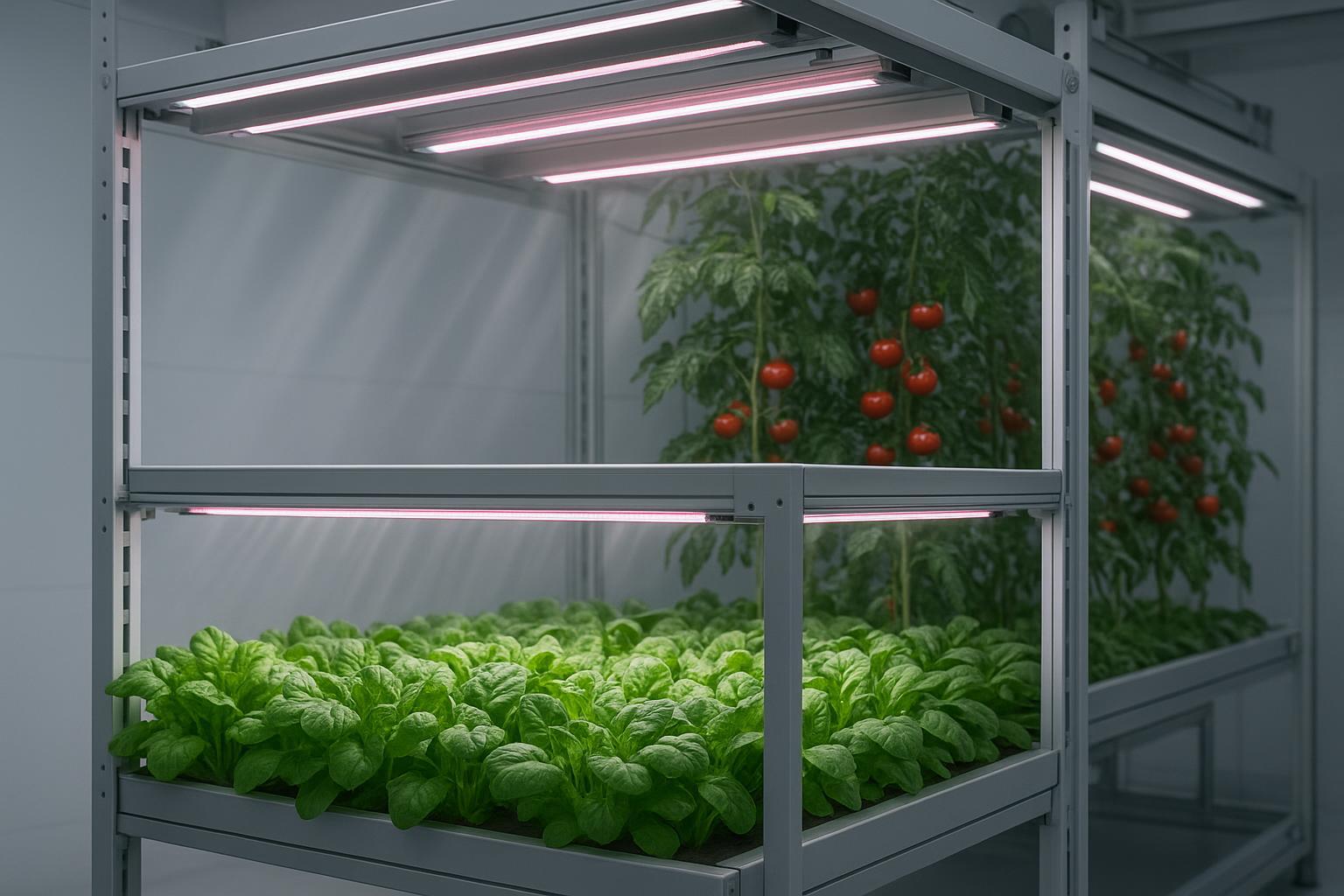
There is no universal distance for grow lights. The right spacing depends on four things that work together: light intensity, fixture type, plant type, and canopy structure. What actually drives growth is how much usable light reaches the canopy—photosynthetic photon flux density, or PPFD—not the height number itself. Small changes in height can swing PPFD a lot, for better or worse, so the job is to tune distance as a control lever to hit target PPFD with good uniformity.
Why There Is No Fixed Grow Light Distance
Distance alone doesn’t decide performance because different fixtures put out different photon densities and spreads at the same hanging height. A narrow panel may torch the center and starve the edges at 30 cm, while a bar array at that height can look even and calm. Move either fixture a little closer and PPFD can spike; move it up and distribution may improve but average PPFD may fall. That’s why distance is only a tool to control light intensity and its distribution across the canopy.
Two practical notes explain most confusion:
- PPFD changes with distance. Even small moves can push a canopy from comfortable to stressed or from underlit to productive.
- Same height is not the same intensity. Optics, diode density, wattage, and beam shape all change what plants actually receive.
When you think in PPFD and uniformity first, “how close” becomes a method, not a number.

Signs Your Grow Light Is Too Close to Plants
Visual symptoms
If the top leaves start to look bleached or whitish, edges feel dry or crisp, or the leaf blades curl upward like a taco, you’re likely running too much PPFD near the surface. Burn spots can appear under the brightest parts of the fixture. Heat can compound these symptoms, but the earliest damage is usually right under the light.
Growth symptoms
Plants may stall despite “strong light.” The upper canopy shows stress first; internodes stay very short in a tense, compact way, and new growth can look narrow or slightly twisted.
Environmental signals
Air feels hotter near the canopy surface, and media dries much faster than expected under the brightest areas. If backing off intensity reduces the hot zone and symptoms ease within a few days, excessive PPFD was part of the problem. Too much PPFD can damage tissues instead of fueling growth.

Signs Your Grow Light Is Too Far from Plants
Visual symptoms
You’ll see stretching with long internodes, thin stems, and a pale or washed-out green across the whole plant. Leaf angles may droop as the crop reaches for light.
Growth symptoms
Development slows, canopy density weakens, and transplant-to-harvest cycles drift longer than plan. Yield potential slides when the plant never gets enough daily photons to build biomass.
Key explanation
Light intensity at the leaves falls quickly as distance increases. If average PPFD drops too low, plants receive far less usable energy, even if the photoperiod is long.

What to Adjust First: Distance vs Dimming vs Layout
Adjust distance carefully
Use small, deliberate moves. Raise or lower by a few centimeters at a time and give the canopy 48–72 hours to respond. Big swings often trade one problem (hotspots) for another (underlit edges).
Use dimming for fine control
Once mounting height is set for decent coverage, dimming is a precise way to hit your average PPFD target without wasting photons off-target. It also avoids pushing the center into stress while you chase edge numbers.
Adjust photoperiod as a secondary lever
Extending light hours increases the daily light integral (DLI), which is the total photons received per day. It won’t fix hotspots, but after distribution is acceptable, it’s a clean way to raise total light. For a concise DLI method, see the PPFD-to-DLI conversion explained by the engineers at Apogee Instruments in their guide on converting instantaneous PPFD to daily totals (2026).
Fix layout if the problem is uneven growth
Uneven growth across trays is a distribution issue, not just a height issue. Re-space bars to improve overlap, stagger fixtures, zone dimming by channel, or add infill lighting to flatten the map. Industry engineering notes discuss uniformity as minimum-to-average ratios and variation across a grid, offering practical ways to improve coverage while keeping energy use sensible.
How Fixture Type Changes the Ideal Distance

LED bar lights
Distributed emitters create overlapping beams and typically more uniform coverage at closer heights. This is why multi-layer vertical farms can run close-canopy strategies responsibly when layout and airflow are dialed in.
Board-style fixtures
A board or panel often drives a strong center with softer edges. You may need a bit more height or a layout change to smooth gradients, then use dimming to land on your average PPFD target without scorching the middle.
Small or narrow lights
Compact fixtures can create intense hotspots. They usually need extra distance or a reconfigured layout to avoid bright streaks and dark gaps.
How Plant Type Affects Grow Light Distance
Seedlings
Young plants have low tolerance for high PPFD and benefit from gentle, even light. Start conservatively and look for steady color, level leaf posture, and measured dry-down.

Leafy greens
Uniformity rules here. Aim for even canopy lighting with moderate PPFD that avoids hotspots over the aisles and weak edges at the walls. University extension guidance commonly places lettuce operations in the mid-200s to mid-300s μmol·m²·s at the canopy, as described by the University of Missouri Extension in their controlled-environment grow-lights overview (2025).

Fruiting crops
Tomato, cucumber, and pepper generally tolerate and benefit from higher PPFD and higher DLI—especially with CO₂ enrichment—so your “right distance” may be closer or your dimmer set higher after you’ve built uniform coverage. Peer-reviewed work in high-tech environments shows growth advantages as DLI rises within reasonable climate limits; see Frontiers in Plant Science for tomato studies exploring DLI and CO₂ interactions (2021).

Quick Planning Benchmarks for PPFD and DLI
All values below are planning bands to help you diagnose and aim—verify on-site with plant response and, when available, PPFD spot checks.
| Crop category | Typical canopy PPFD | Typical DLI | Notes |
|---|---|---|---|
| Seedlings | ~100–200 μmol·m²·s | ~6–10 mol·m²·d | Gentle, even light; watch heat/RH interactions |
| Leafy greens | ~250–350 μmol·m²·s | ~10–17 mol·m²·d | Uniformity across trays is critical (Missouri Extension; VT/GPN DLI context) |
| Fruiting crops | ~600–1,000+ μmol·m²·s | ~20–40 mol·m²·d | Higher targets often paired with CO₂ and strong climate control |
To translate instantaneous PPFD into DLI for your schedule, Apogee’s explanation of PPFD-to-DLI conversion provides the simple math and examples in a clear, engineer-friendly format (2026).
How to Find the Right Distance: A Step-by-Step Method
Step 1: Start with the manufacturer’s baseline. Treat the spec-sheet height and dimmer setting as a safe starting point, not the finish line.
Step 2: Observe the canopy. Color should look healthy; leaves should sit flat and relaxed; growth should be compact without signs of stress or stretch. Feel near the canopy for excess heat and track media dry-down.
Step 3: Measure PPFD if possible. A quick grid confirms real intensity and distribution so you aren’t flying blind. Keep in mind that seedlings often require lower PPFD in the 100–200 μmol·m²·s band and leafy greens around the mid-200s to mid-300s, with fruiting crops trending higher depending on climate and CO₂. For terms and context, review PPFD and PAR together in this overview of how light affects plant growth from FY LIGHTING.
Step 4: Adjust gradually and monitor. Make small moves in height or small changes on the dimmer, then watch the canopy for 48–72 hours. Once distribution looks right, use photoperiod to fine-tune DLI.
Two Practical Micro-Workflows You Can Use Today
- No-meter method for vertical racks
- Set height and dimmer to the manufacturer’s baseline. After 24–48 hours, scan for bleaching, taco leaves, or edge lag. If you see hotspots, raise the fixture 2–5 cm or dim 5–10%; if edges lag, lower a touch or rebalance zones. Re-check 48–72 hours later and repeat small steps until the canopy is even and relaxed. Once distribution is good, extend photoperiod to raise DLI if needed.
- With-meter method for quick verification
- Map a simple 3×3 or 5×5 grid at canopy height on a representative bed. Record PPFD, then check the average and how low the minimum is versus the average. A practical commercial goal is a healthy minimum-to-average ratio and moderate variation across the grid; industry engineering notes from PL Light Systems describe these uniformity ideas and how fixture choice affects them (2021). After you improve coverage with height and layout, use the dimmer to hit your average PPFD, then convert to DLI for your photoperiod plan using Apogee’s method.
Common Mistakes Growers Make
Copying someone else’s distance without considering fixture type, optics, or wattage usually backfires. Dropping lights too low to “chase intensity” often burns the center while the edges still starve. Treat uneven growth as a distribution problem and solve it with layout, spacing, and zoning before you crank power. Don’t expect photoperiod to fix hotspots; it only raises the daily total after intensity and distribution are right. And always re-tune as the canopy climbs—what worked last week can be wrong once plants add 10 cm of height.
So, how far should a grow light be from a plant?
As far—or as close—as needed to deliver the right PPFD evenly, without causing stress. If you run LED bar arrays in multi-layer racks, this often means relatively close heights with careful spacing and modest dimming. If you run board fixtures or narrow lights, it may mean a bit more height or a revised layout first, then dimming. The distance number is not the goal; the canopy PPFD and its uniformity are the goal.

A neutral example from the rack
On a two-tier rack, a row of leafy greens under a bar-style fixture showed slight bleaching in the center and weak growth at the outer 10 cm of the tray. We raised the bars by 3 cm to improve overlap, then reduced output by 10% to pull the center back into a comfortable range. Over 72 hours, color normalized and edge growth matched the middle. This kind of small-step workup is typical with distributed bar fixtures. If you run bar luminaires like the TPB series, you can adjust spacing and dimming the same way to tune PPFD and flatten your map without chasing a single “correct” height. See FY LIGHTING’s RBD LED grow light product page for form factor details.
FAQ
How far should a grow light be from a plant?
There isn’t a single fixed distance. It depends on light intensity, fixture type, and the plant’s tolerance at its current stage. Target canopy PPFD and uniformity, then set distance and dimmer to achieve them.
How close should grow lights be to plants?
Close enough to deliver strong light without bleaching, curling, or burning the top leaves. If stress appears, use small height or dimmer adjustments and re-check after 48–72 hours.
What happens if grow lights are too close?
You may see bleaching, burn spots, taco leaves, faster media dry-down, and stalled growth at the top. Reduce local PPFD with small height increases or slight dimming.
What happens if grow lights are too far away?
Plants stretch, stems thin, and development slows because average PPFD and daily photons are too low. Lower the fixture slightly or increase dimming and, once coverage is even, consider longer photoperiods.
How do I know if my grow light distance is correct?
Healthy color, compact growth, level leaf posture, and even development across the tray are good signs. A quick PPFD grid (if you have a meter) confirms both average levels and uniformity.
Should I adjust distance or dimming first?
Use both together. Set height for coverage and use dimming to land precisely on your average PPFD target. Photoperiod comes after distribution is right.
The real goal: light intensity, not distance
Distance isn’t the outcome—PPFD and uniformity are. The best grow light distance is simply the one that delivers enough light without causing stress. Keep adjustments small, watch the canopy closely, and verify with simple measurements when you can.
Further reading and references
- Learn the math behind converting instantaneous PPFD to daily light totals in Apogee Instruments’ guide to PPFD-to-DLI conversion (2026): https://www.apogeeinstruments.com/conversion-instantaneous-ppfd-to-integrated-ppfd/
- Review leafy-green PPFD operating bands in the University of Missouri Extension’s overview of controlled-environment grow lights (2025): https://extension.missouri.edu/publications/g6987
- Explore how uniformity and light placement affect absorption with top and intra-canopy strategies in Frontiers in Plant Science (2021 and later works): https://www.frontiersin.org/journals/plant-science/articles/10.3389/fpls.2021.615853/full
Internal resources for core concepts
- PPFD (light intensity), daily light integral (DLI), and PAR in lighting, all explained in one place: https://www.fytechsystems.com/ultimate-guide-how-light-affects-plant-growth/
- Bar-style fixture form factor reference (neutral): https://www.fytechsystems.com/vertical-led-grow-lights/


 English