
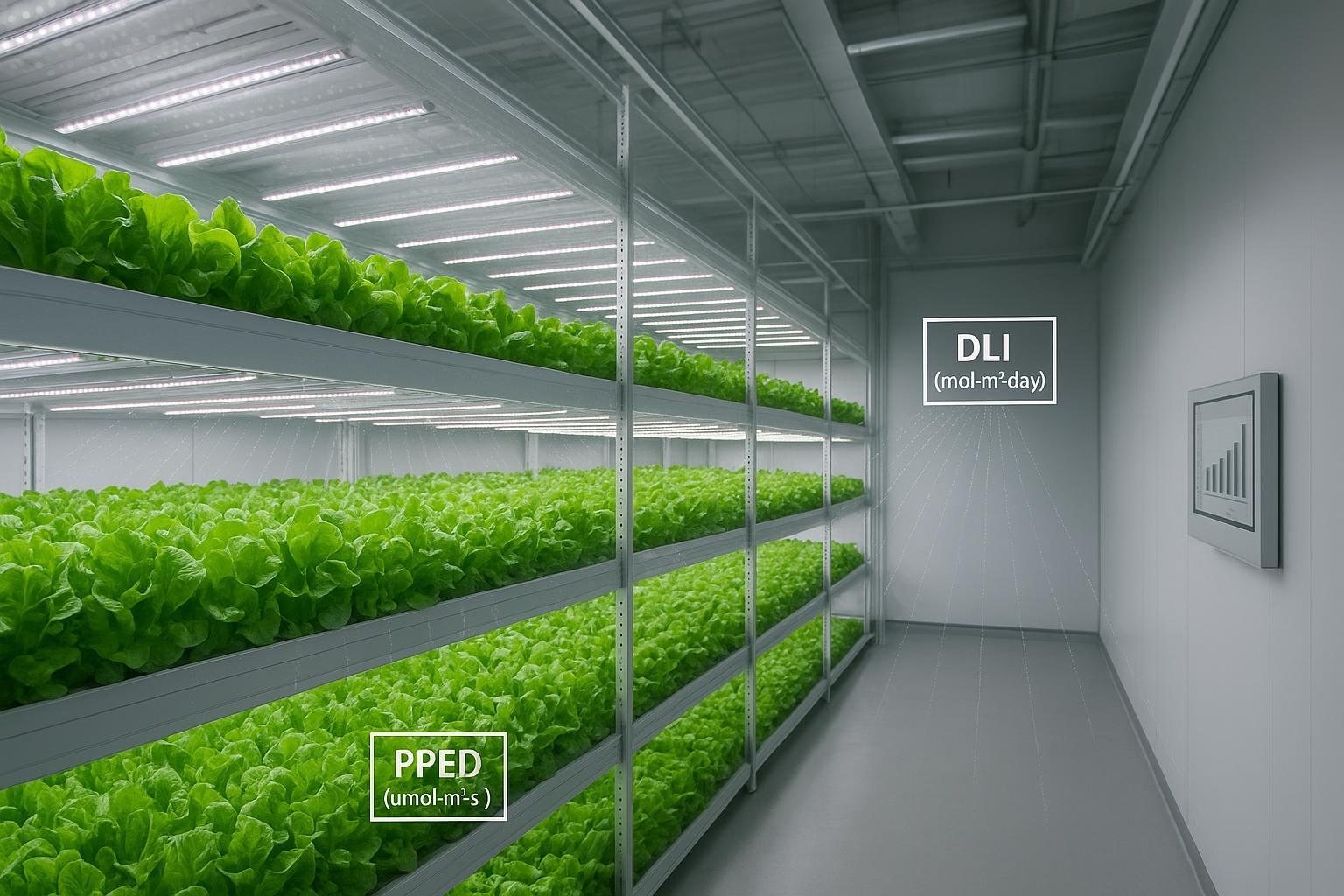
If you manage a greenhouse or vertical farm, you’ve probably asked some version of this question: why is daily light integral important for yield, quality, and consistency? The short answer is that DLI tells you the total number of photosynthetic photons your crop receives each day—your real “light budget.” Get it right, and harvests become more predictable.
Planning a Commercial Indoor Vertical Farm?
Lighting is one of the most important parts of a successful vertical farm, but it works together with growing systems, irrigation, climate control, automation, and crop planning.
For a complete step-by-step guide, read:
👉 How to Build an Indoor Vertical Farm: Complete Commercial Guide
To apply DLI in a complete vertical farm lighting plan, read our Vertical LED Grow Lights Guide for Commercial Vertical Farming for guidance on crop requirements, lighting layout, and commercial LED grow light selection.
What Is DLI
Daily Light Integral (DLI) is the total amount of photosynthetically active radiation (PAR) that hits a square meter of canopy over 24 hours, expressed as mol·m⁻²·day⁻¹. It combines two factors—instant intensity and time—into one daily number. For a concise definition and grower context, see Virginia Tech’s guide on calculating and using DLI in controlled environments in the article Calculating and Using Daily Light Integral (DLI) (2024) from Virginia Tech Extension: Virginia Tech Extension — Calculating and Using Daily Light Integral (DLI).
How DLI Is Calculated
At constant light during the photoperiod, the conversion is straightforward:
- DLI (mol·m⁻²·day⁻¹) = PPFD (μmol·m⁻²·s⁻¹) × photoperiod (hours) × 0.0036
- To find the required PPFD for a target DLI: PPFD ≈ DLI ÷ (hours × 0.0036)
If you’re new to PPFD measurement at canopy height, start with a brief primer and workflow in this internal resource: PPFD measurement.
For additional methods and logging guidance, Apogee Instruments summarizes DLI measurement and equipment options in their technical overview: Apogee Instruments — Daily Light Integral Measurement.
Why is daily light integral important vs PPFD and lux
PPFD is the core instantaneous intensity—what your meter reads right now. DLI is the decision metric—how many photons your crop actually accumulates each day. Two rooms can show the same PPFD at noon, but deliver very different outcomes by lights-off if one runs 12 hours and the other 18.
What about lux and the common question “how many lux for grow lights”? Lux is weighted to human vision, not plant photosynthesis, so it doesn’t translate reliably to plant-useful photons—especially under non-daylight spectra. Michigan State University’s floriculture resources explain why plant decisions should rely on PAR/PPFD and DLI, not human-vision metrics: MSU — Light terminology for plants (Erik Runkle).
Recommended DLI by Crop
Use these ranges as starting points; adjust for cultivar, stage, and environment.
| Crop | Recommended DLI (mol·m⁻²·day⁻¹) | Notes |
|---|---|---|
| Lettuce | 12–17 | Leafy greens respond well within this band; watch heat and tipburn risk. |
| Herbs | 10–20 | Species vary (e.g., basil typically higher within the range). |
| Tomato | 20–30 | Fruiting crops generally need more photons for yield. |
These values align with university extension guidance, such as the 2024 update: Virginia Tech Extension — Calculating and Using Daily Light Integral (DLI).
Practical Calculation Examples
- Forward calculation (estimate DLI from PPFD and hours)
- A veg room averages 200 μmol·m⁻²·s⁻¹ over a 16-hour day.
- DLI = 200 × 16 × 0.0036 = 11.52 mol·m⁻²·day⁻¹.
- Reverse calculation (estimate PPFD needed for a target DLI)
- Target DLI is 20 mol·m⁻²·day⁻¹ on an 18-hour schedule.
- PPFD ≈ 20 ÷ (18 × 0.0036) ≈ 309 μmol·m⁻²·s⁻¹.
If you prefer a tool, a grower-friendly calculator can convert between PPFD, hours, and DLI: Photone — DLI calculator.
How to Optimize DLI Indoors

Here’s a simple workflow you can apply across tiers or zones:
- Measure PPFD at canopy at multiple points; compute the average and note variation.
- Calculate DLI using the formula or a calculator.
- Adjust photoperiod to lift DLI without changing fixture layout when heat headroom is limited.
- Increase PPFD via dimming setpoints, fixture height, or density when you need more photons per second.
- Verify uniformity; fix hot spots and shadows that drag down the average.
- Log daily DLI and review seasonally (for greenhouses) or by stage (indoors).
Operator example (neutral, replicable)
- A tomato tier targets 22 mol·m⁻²·day⁻¹.
- Canopy measurements across nine points average 280 μmol·m⁻²·s⁻¹ at 16 hours, giving roughly 16.1 DLI.
- Extending the photoperiod to 18 hours raises DLI to about 18.1. To close the gap, raise PPFD to ~340 μmol·m⁻²·s⁻¹ at the same 18 hours to reach ≈22.0.
- With scheduling and 0–10 V dimming, fixtures can hold the setpoint as canopy height changes. One example of a system that supports this workflow is the FY LIGHTING TPB LED grow light, which integrates with facility controls for incremental dimming and runtime scheduling. The goal isn’t a specific brand outcome—it’s a repeatable method to hit your target DLI.
Can You Estimate DLI Using Lux
You can estimate, but it won’t be precise—especially under purple/magenta spectra or narrow-band LEDs. Lux answers “what is the light intensity” for human perception, not for plants. Conversion factors to PPFD depend on spectrum and can be off by a wide margin. For plant decisions, use a PAR/quantum sensor or a validated PPFD-capable app, then calculate DLI.
Common DLI Mistakes
- Relying on lux/foot-candle targets instead of PPFD/DLI for grow-light planning.
- Running high PPFD but too short a photoperiod; daily photons still fall short.
- Measuring above the canopy or at too few points, missing non-uniformity that lowers average DLI.
- Chasing peak center PPFD while ignoring fixture height and diffusion, which can reduce uniformity.
Apogee’s overview provides practical methods for logging and interpreting DLI under constant and variable light: Apogee Instruments — Daily Light Integral Measurement.
Related Vertical Farming Lighting Guides
Daily Light Integral (DLI) tells you how much total light your plants receive over a day—but optimizing plant growth requires understanding both the intensity of light at any given moment and the type of light plants can actually use.
To complete your lighting strategy, explore these two essential guides:
👉 How to Measure Grow Light Intensity (PPFD)
Learn how to measure and map PPFD accurately, and how light intensity varies across your growing area.
To set the right DLI target, you also need to know how much PPFD plants need at different growth stages and for different crop types.
👉 What Is PAR in Lighting?
Understand the spectrum of light (400–700 nm) that drives photosynthesis and defines usable plant light.
For a clearer understanding of lighting terminology, review Lux vs PAR vs PPFD vs DLI and learn how each metric is used in commercial grow light design.
Explore how different wavelengths affect crop growth:
👉Plant Light Spectrum Guide
Building a complete vertical farm?
👉Read the Indoor Vertical Farm Guide
FAQ
What is Daily Light Integral (DLI)?
DLI is the total amount of PAR light a plant receives over a 24-hour period, expressed in mol/m²/day.
How is DLI calculated?
DLI is calculated by integrating PPFD over time, combining light intensity and photoperiod.
Why is DLI important for plant growth?
DLI determines the total light energy available for photosynthesis, directly influencing plant growth rate and yield.
What is the relationship between PPFD and DLI?
PPFD measures instantaneous light intensity, while DLI represents the accumulated light over a full day.
Can you increase DLI without increasing light intensity?
Yes, extending the photoperiod (lighting hours) can increase DLI even if PPFD remains the same.


 English