

Chili pepper production asks more of a lighting system than most fruit vegetables do. Yield matters, but so does pungency. Color matters, but so does nutritional density. In some operations, drying quality and pigment concentration are as important as fresh-market weight. No single fixed-spectrum fixture was designed with all of these objectives in mind simultaneously — and that is precisely why adjustable spectrum LED grow lights have become a meaningful tool for commercial chili growers and horticultural researchers working with Capsicum.
Why Chili Peppers Need Different Adjustable Spectrum Targets From Sweet Peppers
Sweet pepper production — covered in a separate article in this series — centers its lighting strategy on a well-defined cluster of commercial outcomes: fruit size, marketable yield, color development, and texture. These goals are important, but they are relatively straightforward to frame.
Chili pepper production complicates the picture. Beyond yield and color, commercial growers and researchers may be optimizing for:
Capsaicin and dihydrocapsaicin concentration (pungency)
Total capsaicinoid content and Scoville Heat Unit (SHU) range
Carotenoid profile, including capsanthin and capsorubin
Phenolic compounds, flavonoids, and antioxidant activity
Vitamin C retention across ripening stages
Dry weight and pigment concentration for processing or export
Flavor complexity beyond heat alone
These traits are not equally affected by the same spectral conditions. And because chili cultivars range from mild Capsicum annuum varieties to superhot C. chinense, with dramatically different genetics, biosynthetic pathways, and fruit architectures, what works well for one cultivar may not work for another.
This is the central argument for adjustable spectrum control in chili production: the “best” spectrum depends on what the grower is trying to produce, in which cultivar, at what stage of the crop cycle. A fixed-spectrum fixture forces a single answer to a question that has multiple valid responses.
How Red, Blue, White and Far-Red Channels Affect Chili Growth and Secondary Metabolism

Understanding what each spectral region does — and where its effects become uncertain — is the foundation for building a useful spectrum strategy.
Blue Channel for Morphology and Secondary Metabolism
Blue light (approximately 400–500 nm) acts primarily through cryptochrome photoreceptors. In chili peppers, it drives several physiologically distinct processes.
At the morphological level, blue promotes compact vegetative growth, regulates stomatal opening, and reduces excessive internode elongation. A study published in Agronomy (2022) on LED light quality effects in pepper seedlings found that blue and UV-A treatments increased seedling compactness and the seedling quality index, while far-red treatments showed inhibitory effects on seedling quality. This makes a meaningful blue component particularly important in the seedling and early vegetative phases.
At the metabolic level, blue wavelengths stimulate secondary metabolism pathways, including the phenylpropanoid pathway responsible for capsaicinoid biosynthesis. This is where research becomes both compelling and inconsistent — a point the following section on capsaicin addresses directly.
Red Channel for Photosynthesis and Fruit Production
Red light (approximately 620–700 nm, with 660 nm as a primary absorption peak) is the primary driver of photosynthesis via phytochrome activation and chlorophyll excitation. In chili peppers, red light supports carbon fixation, biomass accumulation, and source-strength development across the fruiting phase.
However, red light alone is insufficient. Research on pepper biomass has consistently shown that plants grown under red-only LED conditions without any blue component show reduced total biomass compared to red-plus-blue combinations. In a frequently cited pepper study from HortScience (2012), the highest total yield and fruit number under LED conditions was observed under red-plus-blue treatment, not red alone. Phytochrome responses interact with the blue cryptochrome signal — both are needed for well-balanced vegetative and reproductive development.
White and Green Channels for Canopy Penetration and Crop Inspection
A broadband white or green component (often delivered via 5600 K white LEDs in a multi-channel fixture) serves two practical purposes in commercial chili production.
First, green and yellow photons penetrate canopy layers more effectively than red or blue wavelengths, which are absorbed heavily at the upper canopy. For taller chili cultivars or dense plantings, a white channel contributes to photosynthetically active radiation reaching mid- and lower-canopy leaves, supporting consistent source production across the whole plant.
Second, white light supports adequate color rendering for crop inspection. Growers working under purely monochromatic red-blue light have noted difficulty visually assessing leaf color, fruit ripeness, and pest or disease symptoms. A white channel addresses this without compromising spectrum management.
Far-Red Channel for Architecture and Developmental Steering
Far-red light (approximately 700–750 nm) acts primarily through phytochrome equilibrium (Pfr:Pr ratio). Increasing the far-red component shifts the phytochrome system toward the Pr form, which the plant interprets as a shading or extended-day signal.
In chili peppers, far-red additions drive stem elongation and leaf extension — effects that can be useful for managing canopy architecture in tightly spaced systems. In some photoperiodic contexts, far-red combined with red light also accelerates flowering initiation by enabling adequate phytochrome cycling.
The key caution is excessive far-red. Research across multiple pepper species has shown that high far-red fractions reduce chlorophyll concentration, reduce compactness, and can produce overly stretched internodes that complicate fruit load management. The far-red channel is a precision tool: small amounts contribute positively, but the response is not linear.
Important note: Wavelength responses in chili peppers vary between cultivars. A far-red signal that promotes efficient canopy development in one Capsicum annuum variety may produce undesirable elongation in a C. chinense type. The same principle applies to blue and red ratios. Spectrum strategies built from general pepper data should be tested before scaling to a specific cultivar.
Adjusting Spectrum for Chili Seedling and Vegetative Growth
The seedling stage in chili peppers has a clear structural objective: produce plants with strong stems, adequate leaf area, controlled internode length, and sufficient root and shoot biomass to support the long fruiting cycle ahead. Chili peppers are long-season crops, and a poorly structured seedling creates problems that persist through flowering and fruit fill.
At seedling stage, the spectrum recipe may prioritize a higher blue fraction relative to the fruiting-stage recipe. Blue-dominant light during early growth keeps plants compact, supports cotyledon development, and promotes stomatal function that will carry through into vegetative growth. Studies on pepper seedlings under controlled LED conditions consistently report that blue and red-plus-blue treatments improve seedling compactness indices compared to red-only or far-red-supplemented treatments.
The vegetative stage shifts the objective. Sufficient leaf area and canopy source capacity — the photosynthetic infrastructure that supports fruit load — become the priority. Red intensity typically increases relative to blue, supporting carbon fixation and internode extension to a degree, while the blue channel is maintained to avoid excessive elongation and to support stomatal conductance.
Growers using multi-channel adjustable spectrum grow lights can apply this as a practical crop-steering tool: adjust channel outputs at transplant transition without changing fixtures, giving the same hardware a different functional profile for each phase.
This red-to-blue balance is a meaningful crop steering lever, but it should not be borrowed directly from tomato or cucumber recipes. Chili peppers have different internode sensitivity to far-red, different requirements for compact structure, and different timing for the vegetative-to-reproductive transition. Spectrum decisions should originate from chili-specific data wherever possible.
Adjusting Spectrum for Chili Flowering, Fruit Set and Fruit Number
The transition from vegetative to reproductive growth in chili peppers is triggered by a combination of developmental age, temperature, and photoperiod signals — not spectrum alone. Spectrum can support or hinder the process, but growers should be clear that it cannot compensate for environmental stress conditions that compromise reproductive stability.
During the reproductive transition and flower development phase, several physiological processes become sensitive to light quality:
Photosynthate supply to the developing floral structures
Pollen viability, which can be compromised by excessive temperature or light stress
Fruit set rate, which depends on pollination success and initial source-to-sink balance
Fruit number per plant, which is influenced by how the plant manages source-sink competition across simultaneous developing fruits
A spectrum recipe that maintains adequate red for photosynthetic output while preserving a meaningful blue component for stomatal function and secondary signaling generally supports stable reproductive performance. Far-red additions during this phase should be applied carefully, as excessive elongation at the node level can affect inflorescence architecture in some cultivars.
Fruit abortion under stress is a practical concern in commercial chili production. It is important to understand that light stress — insufficient PPFD or an unbalanced spectrum that reduces effective photosynthesis — is one potential contributor. However, water stress, heat stress, and nutrient status interact with light in determining fruit abortion rates. A well-managed spectrum will not rescue a crop from temperature extremes above 32–35°C during anthesis, sustained water deficit, or significant calcium or boron deficiency during rapid fruit expansion. Spectrum is one variable in a multi-factor system.
How Adjustable Spectrum May Influence Capsaicin and Chili Pungency

This section addresses the most commercially significant and scientifically nuanced topic in chili lighting: the relationship between LED spectrum and capsaicinoid concentration.
Capsaicin and Dihydrocapsaicin
Capsaicin and dihydrocapsaicin are the two principal capsaicinoids in most Capsicum species and account for the majority of measured pungency. They are synthesized in the placental tissue of the fruit through a branched biosynthetic pathway involving phenylalanine, valine, and octanoic acid metabolism. The pathway is regulated by environmental signals including temperature, water status, and — importantly — light.
Minor capsaicinoids including nordihydrocapsaicin, homocapsaicin, and homodihydrocapsaicin contribute to overall pungency profile and flavor complexity, but capsaicin and dihydrocapsaicin dominate the SHU measurement.
Scoville Heat Units
The Scoville Heat Unit scale expresses pungency as the dilution factor at which capsaicinoid concentration becomes undetectable to human taste. In practice, commercial and research operations now use HPLC-based capsaicinoid quantification rather than organoleptic testing, converting analytical concentrations to SHU equivalents mathematically. A mild jalapeño may measure 2,000–8,000 SHU; a superhot cultivar such as C. chinense ‘Carolina Reaper’ can exceed 2,000,000 SHU. This range spans three orders of magnitude, reflecting the genetic diversity of Capsicum as a genus.
Light as an Environmental Signal for Capsaicinoid Accumulation
Research on LED spectrum and capsaicinoid synthesis has generated results that are real, meaningful, and genuinely inconsistent across studies. Understanding why the data is inconsistent is more valuable for growers than accepting any single result as universal.
In a study published in HortScience (2012), chili pepper fruits grown under blue LED treatment showed capsaicinoid content of 180 ± 6.32 mg per 100 g, compared to 54 ± 3.12 mg per 100 g under fluorescent control light — a substantial difference that positioned blue as a driver of capsaicinoid accumulation. Blue LED treatment also increased the rate of capsaicinoid production in that study’s cultivar.
A study in Frontiers in Plant Science (2022) that examined growth, flowering, and yield of chilli under modulated light conditions reported a different result: phenolic content and radical scavenging activity were stimulated under blue-enriched treatments, while capsaicin accumulation was suppressed by blue light in that dataset. Total capsaicinoids were reduced under high blue in that experimental system.
A 2025 study published in PubMed found that blue light significantly increased capsaicin by 41.43-fold and dihydrocapsaicin by 4.36-fold compared to white light in in vitro chili cultures. Meanwhile, a 2021 study on ‘Super Hot’ Capsicum annuum found that blue LEDs increased capsaicin, dihydrocapsaicin, nordihydrocapsaicin, homocapsaicin, and homodihydrocapsaicin contents by 43–57% compared to control — a consistent direction, but a different magnitude.
These results are not in contradiction in a scientific sense. They reflect the reality that capsaicinoid responses to light depend on cultivar genetics, the specific spectral treatment applied, light intensity, DLI, plant developmental stage, and co-occurring environmental conditions. The same blue fraction can produce different results in different cultivars, at different intensities, or across different photoperiod lengths.
This is precisely what makes adjustable spectrum fixtures valuable for chili production: a fixed-spectrum solution forces growers to accept one set of spectral conditions across all cultivars and objectives, while a 4-channel controllable system allows spectrum to be matched to the cultivar and the quality target being pursued.
Growers seeking to influence capsaicinoid concentration should treat spectral adjustment as a testable hypothesis for their specific cultivar, rather than applying a blanket “blue increases capsaicin” or “red reduces capsaicin” rule.
How Spectrum, PPFD and DLI Interact to Influence Chili Quality
One of the most common framing errors in commercial grow-light discussions is examining spectral percentages — such as “20% blue” — in isolation from the actual photon delivery those percentages represent. Spectral composition and light intensity are not independent variables; they interact to determine biological outcomes.
Consider a simple example: a spectrum with 20% blue delivered at a PPFD of 200 µmol m⁻² s⁻¹ delivers 40 µmol m⁻² s⁻¹ of blue photons. The same 20% blue fraction at a PPFD of 500 µmol m⁻² s⁻¹ delivers 100 µmol m⁻² s⁻¹ of blue photons. The spectral percentage is identical; the actual blue photon dose the plant receives is 2.5 times higher. The plant experiences a meaningfully different light environment in each case.
In chili pepper production, PPFD and DLI targets vary by growth stage:
Growth Stage | PPFD Target (µmol m⁻² s⁻¹) | DLI Target (mol m⁻² day⁻¹) |
|---|---|---|
Seedling | 150–300 | 6–12 |
Vegetative | 300–450 | 15–22 |
Flowering | 400–600 | 20–28 |
Fruit fill | 450–650 | 22–30 |
Ripening | 300–500 | 18–26 |
A Wittmann et al. (2025) study on Capsicum annuum in vertical indoor farming found that increasing PPFD from 250 to 500 µmol m⁻² s⁻¹ increased dried fruit yield by 33–57% and produced a corresponding increase in capsaicinoid yield per growing area. This finding illustrates that intensity directly influences the absolute amount of secondary metabolites a crop can produce, independently of spectrum.
At the same time, high PPFD combined with an unfavorable spectrum or poor temperature management can induce photoinhibition or stress responses that redirect assimilates away from secondary metabolism. The relationship between light dose and metabolite accumulation is not simply linear.
For growers working with adjustable spectrum chili grow lights, the practical implication is this: evaluating or comparing spectral treatments requires knowing the PPFD and DLI at which each treatment was delivered. A blue-spectrum trial run at 250 µmol m⁻² s⁻¹ and a blue-spectrum trial run at 600 µmol m⁻² s⁻¹ are not the same experiment, and their capsaicinoid outcomes should not be compared directly.
Adjusting Spectrum During Ripening for Chili Color, Carotenoids and Nutritional Compounds

As chili fruit transitions from green to its mature color — whether red, orange, yellow, or brown depending on cultivar — several biochemical shifts take place simultaneously. Chlorophyll degrades, and carotenoid biosynthesis accelerates. This phase is light-responsive, and the spectral environment during ripening can influence the accumulation rate and final concentration of multiple quality compounds.
Carotenoids, capsanthin, and capsorubin: The red and orange color of ripe chili fruits is primarily due to carotenoids, particularly capsanthin and capsorubin, which are synthesized in chromoplasts as chloroplast degradation proceeds. These compounds are also commercially significant: capsanthin-rich peppers command premium prices in paprika and chili powder markets, where color value (often measured by ASTA units) directly influences product grade.
Research published in PMC (2023) on post-harvest chili fruit irradiation found that red and far-red light treatments induced carotenoid accumulation, capsaicinoid content, and ascorbic acid concentration in Capsicum annuum green pepper fruit that had not yet reached full ripeness. This post-harvest finding provides directional evidence that spectral conditions during the final ripening stage can influence the same compound classes during crop production.
Vitamin C (ascorbic acid): Chili peppers are one of the most concentrated sources of ascorbic acid among common vegetables. Its concentration is influenced by cultivar genetics, developmental stage, and environmental conditions including light. Research shows both spectral composition and light intensity affect ascorbic acid retention, and high light can either increase or decrease it depending on the degree of oxidative stress induced.
Phenolics, flavonoids, and antioxidant activity: The phenylpropanoid pathway that contributes to capsaicinoid biosynthesis also feeds phenolic acid and flavonoid production. Several studies have reported that blue-enriched spectra increase phenolic content and antioxidant activity in chili fruit, sometimes in experiments where the same blue spectrum reduced capsaicinoid content. This represents a genuine trade-off: lighting conditions that favor one quality trait do not necessarily favor all others simultaneously.
Distinguishing between quality objectives is therefore essential for the ripening stage recipe:
Pungency optimization targets capsaicinoid content and SHU; requires cultivar-specific spectral testing
Color optimization targets carotenoid concentration (capsanthin, capsorubin) and ASTA color value; relevant for dried and processed chili markets
Nutritional optimization targets vitamin C, phenolics, flavonoids, and radical scavenging activity; relevant for fresh markets and premium nutritional positioning
One spectral recipe will not simultaneously maximize all three. A grower producing dried paprika-style peppers for color value may need a different ripening-stage strategy than a grower producing fresh superhots for pungency-focused retail.
Defining an Adjustable Spectrum Goal for Yield, Pungency, Color and Nutrition
Because the quality objectives for chili production are diverse and sometimes mutually exclusive in their lighting requirements, spectrum strategy should begin with a clearly defined production goal.
The table below provides a framework for matching production objectives to lighting strategy priorities:
Production Objective | What to Measure | Lighting Strategy Should Prioritize |
|---|---|---|
Maximum Yield | Fruit number, fresh weight, dry weight | Source strength and total DLI delivery |
High Pungency | Capsaicinoids (mg/100g), SHU | Cultivar-specific spectrum testing; blue/red ratio adjustment |
Strong Red Color | ASTA color value, carotenoids (capsanthin) | Ripening-stage spectral response; red and far-red management |
Nutritional Quality | Vitamin C, phenolics, flavonoids, antioxidant activity | Quality-focused spectrum trials, balanced blue component |
Seed Production | Flowering stability, seed set, seed development | Reproductive stability; consistent PPFD, avoid stress signals |
Research | Multiple physiological and metabolic traits | Full independent channel control for variable isolation |
The research row deserves attention: for universities, breeding programs, and commercial growers conducting internal variety trials, the ability to independently control each spectral channel — without changing fixtures — is a direct experimental requirement, not a preference.
FY LIGHTING’s 4-channel adjustable spectrum systems offer this capability by design. A standard research configuration might assign CH1 to 660 nm red, CH2 to 450 nm blue, CH3 to 5600 K broadband white, and CH4 to 730 nm far-red — each adjustable from zero to full output independently while the same fixture remains installed. This configuration allows a single facility to test multiple spectral hypotheses across cultivars and growth stages without hardware changes between treatments.
Chili pepper is arguably the strongest application case for this architecture in the vegetable category, precisely because the quality traits it produces are so diverse and so light-responsive.
Building Stage- and Cultivar-Specific Adjustable Spectrum Recipes for Chili Peppers
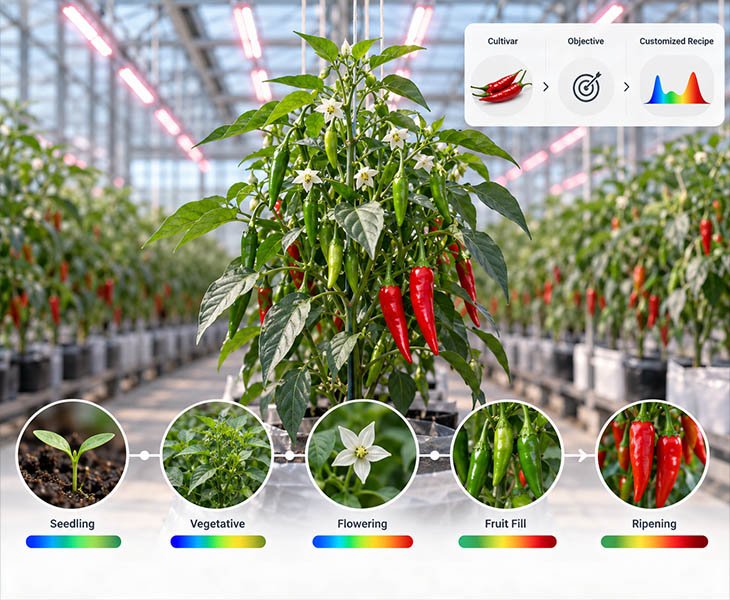
What follows is a framework for thinking about spectrum management across the chili production cycle. It deliberately avoids assigning fixed channel percentages, because the appropriate recipe depends on cultivar, facility environment, PPFD level, and the production objective established in the previous section. The goal here is to define what each stage should achieve and what spectral priorities support that objective.
Stage 1 Seedling Spectrum Goal
Target: compact, structurally strong plants with good root establishment.
The seedling recipe should deliver adequate blue to support compact internode development and strong stem structure, while maintaining enough red for basic photosynthesis and chlorophyll synthesis. The PPFD at this stage is lower than at production, so the absolute blue photon dose is inherently moderate even with a relatively high blue fraction. Far-red should be minimal at seedling stage — it promotes elongation that conflicts with the compactness objective.
Stage 2 Vegetative Spectrum Goal
Target: sufficient canopy development and photosynthetic source capacity.
As plants grow toward their pre-flowering size, the spectrum recipe shifts toward building biomass. Red increases to support carbon fixation; blue is maintained to regulate stomatal function and prevent excessive stretch. A moderate white component contributes to canopy penetration in denser plantings. Far-red may be introduced conservatively if internode extension is needed for canopy architecture, particularly in tall cultivars.
Stage 3 Flowering Spectrum Goal
Target: stable reproductive development and fruit set.
The priority during flowering is photosynthetic consistency — the plant needs a reliable carbohydrate supply to support pollen development, anthesis, and initial fruit cell division. Excessive spectral stress at this phase can reduce fruit set. The spectrum recipe from Stage 2 can be maintained or adjusted to increase the total PPFD delivery if DLI is insufficient, but major spectral rebalancing during flowering introduces unnecessary variability.
Stage 4 Fruit-Filling Spectrum Goal
Target: sustained photosynthate production and fruit load management.
Fruit filling is metabolically intensive. The demand for carbon from developing fruits is high, and source strength must keep pace with sink demand to prevent fruit abortion. A high-red, maintained-blue recipe with adequate PPFD and DLI is generally the priority. The white channel supports lower-canopy lighting where dense foliage limits top-light penetration. Far-red can contribute to canopy extension if light interception is limiting yield.
Stage 5 Ripening Spectrum Goal
Target: color development, capsaicinoid accumulation, antioxidant compound accumulation, or a defined combination — depending on the production objective.
The ripening stage is where the production objective established earlier matters most. A pungency-focused recipe may test blue channel contributions based on cultivar-specific data. A color-focused recipe may emphasize red and moderate far-red based on carotenoid biosynthesis pathways. A nutritional quality focus may prioritize a balanced spectrum with a maintained blue component.
Growers using multi-channel adjustable spectrum fixtures can alter channel output at each of these stages without replacing hardware, replacing lamps, or reconfiguring the growing system. The fixture design accommodates the production objective; the grower defines the recipe.
Why 4-Channel Adjustable Spectrum Control Is Useful for Chili Research
Chili peppers occupy an unusual position in horticultural research: they are commercially important enough to justify controlled-environment studies, but their quality traits are diverse enough that each study tends to focus on a narrow subset of outcomes. Light spectrum research in Capsicum has examined morphology, flowering, capsaicinoid content, carotenoids, phenolics, and antioxidant activity — often in separate studies, with different spectral treatments and intensity conditions.
This fragmentation in the published literature is partly a consequence of research equipment limitations. Fixed-spectrum grow lights constrain what hypotheses a researcher can test. A fixture with one broadband spectrum can answer questions about light level and photoperiod but cannot isolate the contribution of any specific spectral region.
A 4-channel fixture with independent channel control removes that constraint. Consider a research configuration such as:
CH1: 660 nm red
CH2: 450 nm blue
CH3: 5600 K broadband white
CH4: 730 nm far-red
Each channel can be independently increased, decreased, or disabled while the same fixture remains installed. This enables experimental designs that fix total PPFD while varying spectral composition, or that vary PPFD while holding spectral ratios constant — conditions necessary to answer mechanistic questions about how spectrum and intensity interact to influence capsaicinoid or carotenoid accumulation.
Applications for this architecture include:
University horticultural departments studying secondary metabolism in Capsicum
Breeding programs evaluating how new cultivars respond to spectral variation
Growth chambers running controlled environment experiments on chili quality traits
Commercial growers running in-house variety trials before committing to a fixed production recipe
Vertical farming operators testing crop steering strategies for premium chili production
The ability to ask “what does this specific spectral region contribute, at this specific intensity level, in this specific cultivar” is what makes independently controllable channel architecture valuable for chili research. It is not primarily a commercial production convenience — it is a scientific capability.
Choosing Adjustable Spectrum Grow Lights for Commercial Chili Production
Selecting a commercial grow light for chili production requires evaluating more than the spectral channels available. Several specification areas materially affect whether the system will perform as designed across a production cycle.
Output and PPFD delivery: The fixture must deliver sufficient PPFD at the target mounting height to reach the recommended production range of 400–600+ µmol m⁻² s⁻¹ at canopy level. PPFD claims should be verified against third-party photometric data or an independent light map, not manufacturer marketing materials. Required wattage depends on mounting height, target PPFD, and coverage area.
Uniformity: Commercial chili production requires consistent light distribution across the canopy to produce consistent fruit development and quality. Uniformity metrics (typically expressed as the ratio of minimum to maximum PPFD across the coverage area) should be reviewed alongside peak PPFD numbers.
Channel control: Independently controllable channels — each adjustable from 0 to 100% without affecting the others — are what enable stage-specific recipe management. Confirm that the fixture’s control architecture supports per-channel dimming, not just whole-fixture dimming.
Dimming and control integration: 0–10 V analog dimming is standard in commercial greenhouse applications; some operations require DALI or proprietary control integration for centralized management. Confirm compatibility before specifying.
Environmental protection: Chili production in commercial greenhouses involves humidity, irrigation splash, and condensation. IP65 or higher protection ratings are appropriate for most greenhouse and indoor farm environments.
Efficiency: High photon efficacy (µmol/J) reduces operating cost over the production cycle. For a long-season crop like chili, energy efficiency has meaningful impact on total cost of ownership.
Mounting height and fixture size: Greenhouse bay dimensions, mounting structure, and target coverage area all constrain fixture options. Bar-style and linear fixtures designed for row coverage differ significantly from broad-area panels.
Rather than matching chili growers to a predetermined “chili spectrum” fixture, a more durable approach is to configure the system around:
The specific cultivar(s) being produced
The quality traits being targeted (yield, pungency, color, nutrition)
The growing environment (greenhouse versus full-indoor versus vertical farm)
The required PPFD at canopy level given mounting height and layout
The number of independent spectral channels needed for the production or research objective
The control strategy (manual adjustment, scheduled recipe change, sensor-driven automation)
FY LIGHTING’s adjustable spectrum grow lights are configured around this kind of requirement-first process. Engineering review of the cultivar objective, growing environment, and spectral channel requirements before fixture specification produces a more defensible system than selecting from a published product spec sheet alone.
Frequently Asked Questions About Adjustable Spectrum Lighting for Chili Peppers
What spectrum is best for chili peppers?
There is no single best spectrum. The optimal spectral condition depends on the cultivar, the production objective (yield, pungency, color, nutrition), and the growth stage. A red-plus-blue combination with a maintained white component performs well for general commercial production, but growers targeting specific quality traits — especially capsaicinoid concentration — should run cultivar-specific spectrum trials before committing to a fixed recipe.
Does blue light increase capsaicin?
Some studies have reported increased capsaicinoid content under blue LED conditions compared to fluorescent or broad-spectrum control light. Other studies have found the opposite. The discrepancy reflects genuine variability in cultivar response, light intensity level, DLI, plant age, and co-occurring environmental conditions. Blue light cannot be described as reliably increasing capsaicin across all cultivars and conditions.
Can grow lights make chili peppers hotter?
Grow lights can influence the spectral environment that affects capsaicinoid biosynthesis, but pungency is primarily determined by cultivar genetics and environmental conditions across the whole growing period — temperature, water status, nutrient availability, and fruit age all contribute. Lighting is one variable among many. Expecting spectrum adjustment alone to produce a reliably hotter crop ignores the other factors that govern capsaicinoid accumulation.
Does light intensity affect chili pungency?
Yes. Research on Capsicum annuum in vertical indoor farming has shown that increasing PPFD from 250 to 500 µmol m⁻² s⁻¹ increased dried fruit yield by 33–57% and produced a corresponding increase in total capsaicinoid yield per growing area. Light intensity affects the total metabolic output of the plant, which influences how much substrate is available for secondary metabolite synthesis. Spectral percentage alone is not sufficient to evaluate the light environment — the absolute photon dose in each spectral band matters.
What PPFD should chili peppers receive?
PPFD targets vary by growth stage. Seedlings typically receive 150–300 µmol m⁻² s⁻¹; vegetative plants 300–450 µmol m⁻² s⁻¹; flowering and fruiting plants 400–650 µmol m⁻² s⁻¹. Commercial operations targeting high yield and good secondary metabolite accumulation generally work in the 400–600 µmol m⁻² s⁻¹ range during production. These targets assume adequate photoperiod to reach production DLI goals.
What DLI is suitable for chili production?
For commercial chili production, the commonly cited DLI range during the production phase is 20–30 mol m⁻² day⁻¹. Seedling stages require 6–12 mol m⁻² day⁻¹. Research from greenhouse vegetable production databases has confirmed that DLI below 20 mol m⁻² day⁻¹ is typically below optimal for fruiting pepper crops. The formula DLI = PPFD × photoperiod (hours) × 0.0036 connects canopy intensity to daily light dose.
What spectrum helps chili peppers turn red?
Color development in ripe chili fruit is driven primarily by carotenoid biosynthesis — capsanthin and capsorubin — as chlorophyll degrades. Research on post-harvest light irradiation of Capsicum annuum found that red and far-red wavelengths accelerated carotenoid accumulation. During the production ripening stage, maintaining adequate PPFD and ensuring the fruit has sufficient developmental time appear to be more reliably influential than any specific spectral shift, though red-dominant light during ripening is consistent with the carotenoid biosynthesis pathway’s known photobiological responses.
Does far-red light help chili peppers flower?
In some cultivar and photoperiod contexts, far-red combined with red light can support earlier flowering by enabling adequate phytochrome cycling. However, chili peppers are generally day-neutral for flowering, meaning they do not require a specific photoperiod signal the way short-day or long-day ornamental crops do. Far-red additions are more reliably used for canopy architecture management in chili than as a primary flowering trigger.
Should chili spectrum change during fruit ripening?
Yes, if the production objective is quality-focused rather than purely yield-focused. The carotenoid biosynthesis pathway, ascorbic acid accumulation, and phenolic content all respond to the light environment during ripening. If a grower is optimizing for ASTA color value, capsanthin concentration, or antioxidant content, a ripening-stage recipe designed around those objectives — and then tested against cultivar response — is more rational than maintaining the same fruiting-phase recipe through to harvest.
Why are 4-channel grow lights useful for chili research?
Because chili pepper quality traits are diverse, light-responsive, and show significant cultivar variation, controlled experiments that isolate the contribution of specific spectral regions require independent channel control. A 4-channel fixture allows researchers to fix total PPFD while varying spectral composition, or to vary a single channel while holding all others constant. This is a scientific requirement for mechanistic studies on capsaicinoid, carotenoid, or antioxidant responses to light — not a commercial convenience. Research institutions, breeding programs, and commercial growers running internal variety trials all benefit from this flexibility.
For engineering review of adjustable spectrum configurations for commercial chili production or research applications — including cultivar-specific spectrum planning, PPFD layout, and control integration — contact the FY LIGHTING technical team.


 English